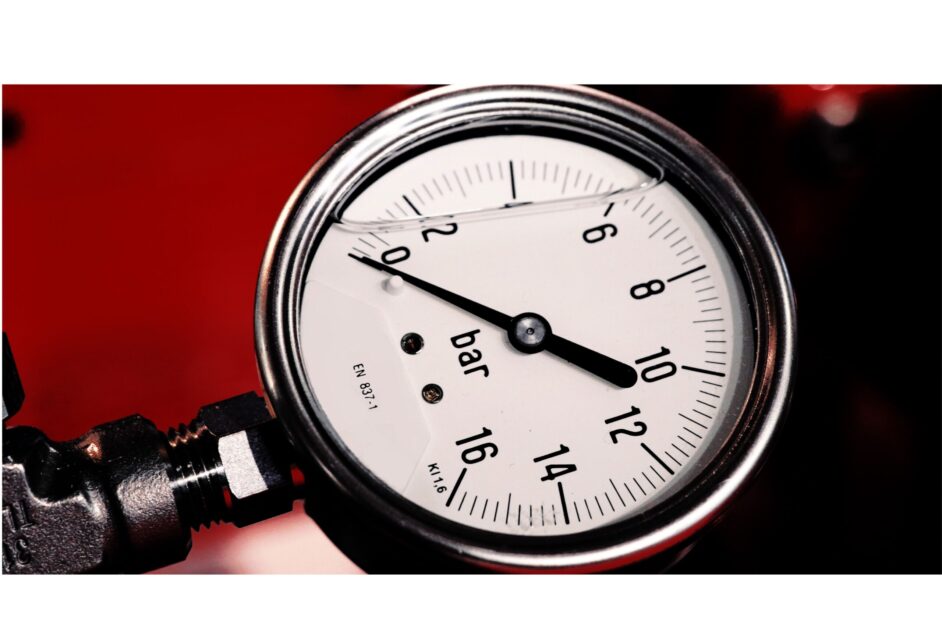
Low water pressure in your house is often caused by a closed main shut off valve, a clogged faucet aerator, a faulty pressure regulator, or a leak somewhere in the plumbing system. Normal household water pressure should read between 45 and 80 psi on a pressure gauge.
Here in the Las Vegas Valley, though, “normal” has a little more range than that. The Las Vegas Valley Water District’s system runs anywhere from 30 to 100 psi depending on your elevation and which pressure zone you’re in, so what’s normal for a home in Summerlin can look different from what’s normal for a home near the Strip. We’ll walk through the usual causes first, then get into what makes our valley its own animal.
In a hurry? Call EcoWater Systems Las Vegas at (702) 485-3583 or request your free quote. Hablamos español.
Quick Diagnostic Steps
Before you call anyone, a few minutes of checking can point you straight to the problem.
- Check the valves. Make sure your main water supply valve and your water meter valve are fully open. Both can get bumped partially closed during maintenance or plumbing work and nobody notices for weeks.
- Test the fixtures. Is it just one faucet or showerhead, or is the whole house affected? That answer alone rules out or points to about half the causes below.
- Inspect the aerators. Unscrew the aerator on the tip of your faucet and check for trapped dirt, rust, or mineral buildup. A quick soak in white vinegar usually dissolves stubborn scale, and in our water, there’s usually plenty of it.
- Test your PSI. A water pressure test gauge screws right onto an outdoor hose spigot and gives you a real number in seconds. These run just a few dollars at any home improvement store.
- Verify with the municipal supply. Contact LVVWD or your local water provider to rule out a main break or scheduled maintenance in your neighborhood.
- Check the pressure regulator. If pressure is low everywhere in the house, not just one fixture, your pressure regulating valve (PRV) may have failed or drifted out of adjustment.
Is It One Fixture or the Whole House?
This is the fastest way to narrow things down. If pressure is weak in one shower or one sink, the problem is almost always local to that fixture (think clogged aerator or cartridge). If it’s weak everywhere at once, you’re looking at something upstream, like a valve, a regulator, or a supply issue.
| Symptom | Likely Cause | What To Do |
| Low pressure at one faucet or showerhead | Clogged aerator or showerhead | Clean or soak in vinegar; replace if it’s an older fixture |
| Low pressure throughout the house | Closed valve, failing regulator, or main supply issue | Check valves first, then test PSI, then call a plumber if it persists |
| Low pressure only with hot water | Sediment buildup in the water heater | Have your water heater flushed by a professional |
| Sudden drop, no warning | Leak, main break, or regulator failure | Check for wet spots, contact LVVWD, call a plumber if it’s isolated to your home |
| Gradual decline over months or years | Scale buildup from hard water | This is where a water softener typically makes the biggest difference |
7 More Complex Causes of Low Water Pressure
If the quick fixes above didn’t restore your pressure, the issue is probably a step deeper.
1. Pipe scaling and corrosion
Older galvanized steel pipes are especially prone to this. Minerals build up along the interior walls over years, gradually narrowing the passageway your water has to move through. It’s a slow squeeze, not a sudden blockage, which is exactly why it’s easy to miss until pressure has dropped noticeably.
2. Water heater sediment
If your cold water pressure is fine but your hot water is weak, sediment collecting at the bottom of your water heater tank is a common culprit. This is a maintenance item, not a red flag, and a professional flush usually resolves it.
3. Hidden leaks
A drop in pressure can point to a leak somewhere in your main lines, even if you don’t see standing water. Watch for unexplained jumps in your water bill or damp spots on walls, ceilings, or flooring.
4. Well system issues
For homes on a private well, a failing pump, a waterlogged pressure tank, or a clogged filtration system can all reduce pressure. This requires a well specialist rather than a general plumber.
5. Shared water lines
Some homes, particularly older ones, share a supply line with a neighbor. When they run a dishwasher or water the lawn, you feel it.
6. Undersized branch lines
If your main supply line is fine but pressure drops at specific fixtures, the smaller pipes branching off to those fixtures may simply be too narrow for current household demand.
7. Municipal or city changes
Occasionally a city adjusts water regulations or infrastructure in ways that affect neighborhood-wide pressure. If everyone nearby is affected, this is worth ruling out early.
Why Las Vegas Homes Are Especially Prone to Water Pressure Problems
Every city deals with clogged pipes and worn out regulators. But a few things about our valley make water pressure its own conversation here.
Elevation and gravity fed pressure zones
The Las Vegas Valley spans a wide range of elevation, from around 2,000 feet near the Strip to more than 3,500 feet in parts of Summerlin near Red Rock Canyon. LVVWD’s system is gravity fed from reservoirs, so your pressure depends heavily on how your property sits relative to the reservoir serving your area. Two homes just a few miles apart can be on entirely different pressure zones with different baseline pressure, simply because of where they sit in the valley.
Seasonal peak demand
Summer in Las Vegas means pools filling, irrigation running, and swamp coolers or AC systems pulling water, often all at once across a neighborhood. That kind of demand can strain an already elevation-stressed system, which is part of why LVVWD activates additional pumps during peak season.
Hard water scale, our specialty
This is where our valley’s water quality plays a direct role. According to the Las Vegas Valley Water District, local water hardness averages around 16 to 17 grains per gallon, well into the “very hard” category (anything above 10.5 grains per gallon qualifies). For context, the U.S. Geological Survey estimates roughly 85% of U.S. homes have some degree of hard water, but Las Vegas sits at the extreme end of that range.
That mineral load means scale builds up inside your pipes and fixtures faster here than in most American cities, gradually narrowing the very passageways your water needs to travel through, the same “pipe scaling” cause described above, just accelerated by our local water.
Older neighborhoods
Homes with original galvanized piping face a double challenge: natural corrosion over time, compounded by the same hard water scale buildup affecting the rest of the valley.
Hard water isn’t a health hazard, but it is hard on everything it touches, and weakened pressure over time is one of the quieter ways it shows up.
DIY Fix or Call a Plumber?
| Task | Difficulty | DIY or Call a Pro |
| Cleaning a clogged aerator | Easy | DIY |
| Checking if valves are fully open | Easy | DIY |
| Testing PSI with a gauge | Easy | DIY |
| Adjusting a pressure regulator | Moderate | Call a pro (easy to over or under adjust) |
| Replacing a pressure regulator | Advanced | Call a pro |
| Locating and repairing a hidden leak | Advanced | Call a pro |
| Flushing water heater sediment | Moderate | Call a pro |
| Removing pipe scale or replacing corroded pipes | Advanced | Call a pro |
| Addressing hard water at the source | Ongoing | A water softener handles this long term |
When to Call a Professional
Most plumbing checks are fine to handle yourself: checking valves, testing PSI, cleaning an aerator. But a few situations call for an expert right away:
- A sudden, unexplained drop in pressure throughout the house
- Suspected leaks in your main water lines
- A pressure regulator that needs replacing, not just adjusting
- Well system pump or pressure tank issues
- Pressure that’s been declining gradually for months, which often points to scale buildup deep in your plumbing
If you’ve worked through the quick fixes and pressure is still weak, or if the cause seems to trace back to Las Vegas’s hard water rather than a single part or valve, that’s worth a conversation with a local water treatment specialist.
How EcoWater Systems Las Vegas Can Help
We’re not a national franchise that happened to open a location here. EcoWater Systems Las Vegas has served Southern Nevada since 1983, which means we’ve spent over 40 years watching exactly how this valley’s water affects local homes, plumbing included. As an authorized EcoWater dealer backed by Berkshire Hathaway, we install systems from the world’s largest manufacturer of residential water treatment equipment, assembled about 95% in the USA, and built to run for less than $2 a year in operating cost.
If scale buildup from hard water is contributing to your pressure problems, a properly sized water softener addresses the root cause rather than just the symptom. Our free in-home water test will tell you exactly how hard your water is and whether a water softener makes sense for your home.
Ready to get to the bottom of it? Call EcoWater Systems Las Vegas at (702) 485-3583 or request your free quote today. We’re located at 7060 W. Warm Springs Road, Suite #160, Las Vegas, NV 89113. Hablamos español.
Water Pressure FAQs
Why does my house suddenly have low water pressure?
A sudden drop usually points to something specific: a partially closed valve, a new leak, a municipal main break, or a water pressure regulator that failed rather than gradually drifted. Gradual decline over months, on the other hand, is more often scale buildup or aging pipes.
What is normal water pressure for a Las Vegas home?
Nationally, 45 to 80 psi is considered normal. In the Las Vegas Valley, LVVWD’s system operates between about 30 and 100 psi depending on your elevation and pressure zone, so your home’s normal may sit outside the national range without anything being wrong.
Can hard water actually cause low water pressure?
Yes. Over time, dissolved minerals from hard water form scale deposits on the interior walls of pipes and fixtures, gradually narrowing the space water has to flow through. In a high hardness market like ours, this happens faster than in most parts of the country.
Will a water softener fix low water pressure?
A softener won’t fix a closed valve or a failed regulator, but it addresses the mineral buildup that causes scale related water pressure loss over time, and it helps prevent new scale from forming in your pipes and fixtures going forward.
Can plumbers fix low water pressure in homes?
Yes, for most of the mechanical causes (valves, regulators, leaks, corroded pipes). For hard water related scale buildup specifically, a licensed water treatment specialist is the right call alongside or instead of a plumber, depending on the situation.